
DonorOps vs. CRM
DonorOps is not an AI feature inside a CRM.
Traditional platforms centralize donor work by moving your organization into their platform model. DonorOps centers your nonprofit's governed donor context first, then brings approved AI and operating capabilities into that environment.
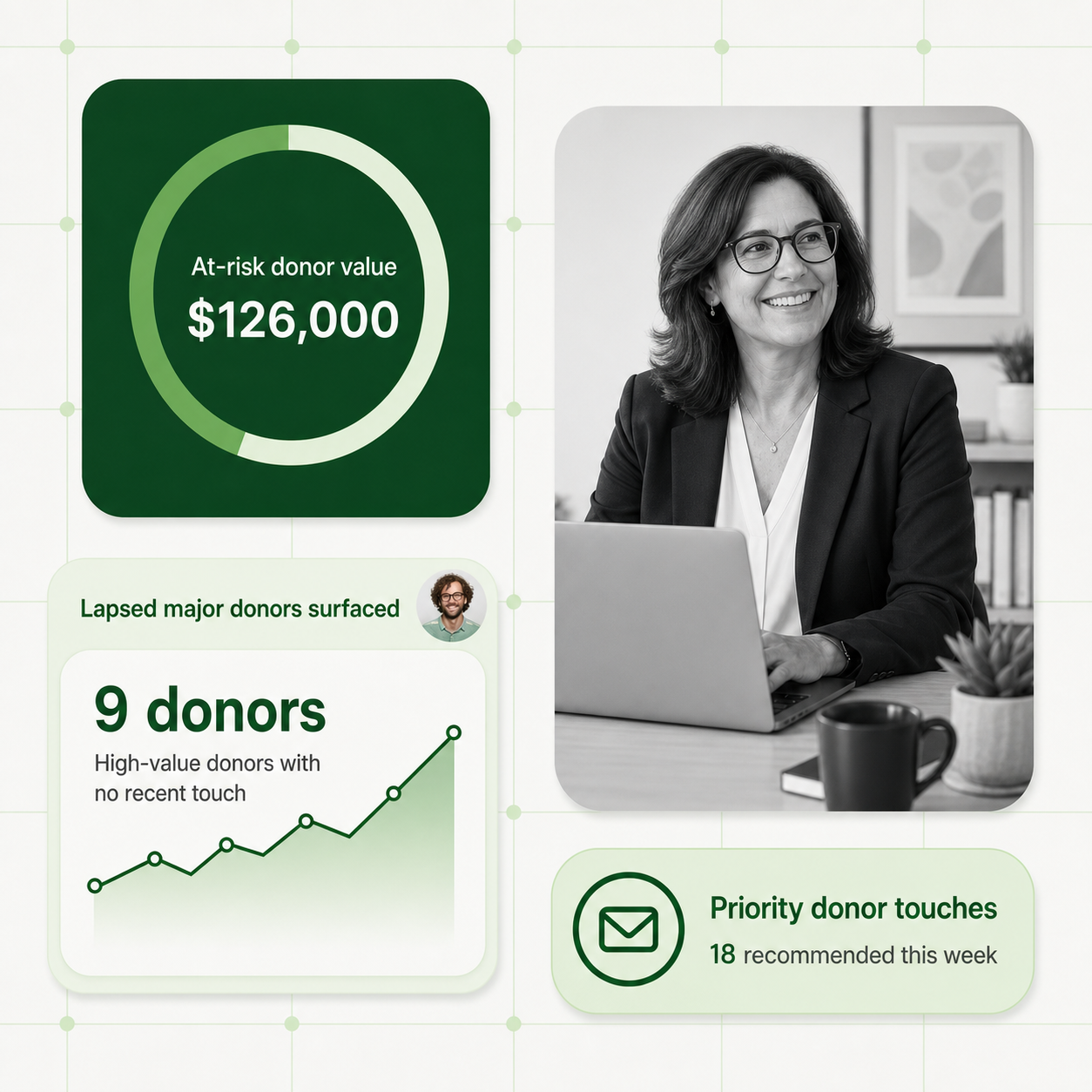
What is the architectural difference?
Traditional platforms pull your donor data into their world. DonorOps brings secure AI into yours, so your team can see who needs attention, prepare the next conversation, and move every donor relationship forward.
Why This Matters
Most nonprofits do not have a donor data problem first. They have a donor operating problem.
Your donor information may already exist somewhere: a CRM, giving platform, spreadsheet, inbox, meeting note, board report, or staff memory. The problem is that scattered donor data does not naturally become donor action.
Follow-ups depend on memory
Important donor next steps can live in someone's inbox, notes app, spreadsheet, or head. When that happens, relationships leak.
Leadership lacks visibility
Development leaders do not just need historical totals. They need movement, ownership, risk, and next action.
AI creates trust questions
Donor records can include sensitive context. Donor data deserves more protection than a generic prompt box.
CRM vs. DonorOps
CRM-centric platform model vs. DonorOps model.
This is not about saying every CRM is bad. The point is to define the destination: governed donor context at the center, approved AI inside the operating boundary, and a path to replace fragmented tools over time.
| Question | Traditional CRM-centric model | DonorOps model |
|---|---|---|
| What sits at the center? | Vendor platform | Nonprofit's governed donor context |
| Where does AI live? | Inside the vendor ecosystem | Inside the nonprofit's operating boundary |
| What persists if models change? | Platform data plus vendor AI workflows | HeartBeat context and action history |
| What expands over time? | More vendor modules | Pulse Packs and approved tools |
| Migration path | Move deeper into platform | Connect, consolidate, replace |
| Trust model | Vendor controls | Permissions, logging, and human review |
DonorOps can connect to legacy CRMs during transition. The point is not to deny the transition phase. The point is to define the destination.
The Core Difference
The nonprofit's governed donor context should be the center.
Where is the record?
CRM-centered systems make the vendor platform the center of gravity for data, workflows, AI features, modules, pricing, and roadmap.
What donor work needs to happen next?
DonorOps makes HeartBeat the governed donor operating core, then uses Pulse Packs and Pulse Companion to move donor work inside your nonprofit's operating boundary.
What About AI Inside CRMs?
CRM AI is usually AI inside the CRM. DonorOps brings AI securely into your governed donor world.
Many nonprofit CRMs now include predictive AI, chatbot-style assistants, content generation, reporting prompts, or donor scoring. Those tools can help. DonorOps is different because it is built around governed donor context, permissions, durable memory, and human-reviewed relationship work.
What might happen?
Predictive AI can estimate giving likelihood, suggest segments, or point users toward records that may deserve attention.
Can you summarize this?
Chatbot-style AI can help users draft content, summarize records, or generate reports within a specific system.
What should our team do next?
Pulse Companion prepares, organizes, summarizes, and surfaces donor work from approved HeartBeat context inside a controlled permission boundary.
| Capability | CRM AI | DonorOps |
|---|---|---|
| Keeps the nonprofit's donor context at the center | No | Yes |
| Treats AI models as replaceable providers | No | Yes |
| Uses approved HeartBeat context | Partial | Yes |
| Runs modular donor-operation capabilities | Vendor modules | Pulse Packs |
| Moves work through governed AI workers | Platform-dependent | Pulse Companion |
| Preserves human review for sensitive actions | Varies | Built for this |
Donor data deserves more protection than a prompt box.
Donor records can include giving history, family context, sensitive life events, staff observations, private preferences, and relationship strategy. DonorOps is designed so AI can assist the work without turning donor trust into casual prompt material.
Keep a complex CRM if your workflows truly need it.
If your nonprofit has a mature Salesforce-style environment with custom objects, deep integrations, trained admins, and workflows your team actually uses, DonorOps may not be the right replacement.
Your CRM runs genuinely complex workflows your team already depends on.
You have trained CRM admins and a clean operating process around it.
Your donor work is already assigned, visible, and reported without manual spreadsheet support.
You mainly need to keep a complex enterprise system in place, not simplify the donor stack.
DonorOps is strongest when the CRM is not where the real work happens.
If your donor work is split between a lightweight CRM, spreadsheets, notes, reports, and memory, DonorOps can become the single donor pulse your team runs instead.
Your CRM is mostly an expensive contact database or email tool.
Donor context lives across a CRM, spreadsheets, reports, notes, and staff memory.
Follow-ups slip because no one owns the weekly rhythm.
You want to eliminate duplicate tools and run donor work from one secure DonorOps pulse.
How DonorOps Works
Start with HeartBeat. Add Pulse Packs. Activate Pulse Companion when you are ready.
DonorOps is designed to meet your nonprofit where it is today, then help you connect, consolidate, and replace fragmented donor tools over time.
HeartBeat
HeartBeat is where your nonprofit's donor context becomes governed, usable, and durable. It brings donor records, relationship history, permissions, workflow state, institutional memory, and AI action history into one secure operating core.
Read about HeartBeatPulse Packs
Pulse Packs add modular donor-operation capabilities to HeartBeat so your team can retire disconnected software, exports, and manual workflows one operating function at a time.
Read about Pulse PacksPulse Companion
Pulse Companion is governed AI work that uses approved HeartBeat context, Pulse Pack capabilities, connectors, tools, and permissions to prepare, analyze, draft, and advance donor work while your team stays in control.
Read about Pulse CompanionFAQ
Common questions about DonorOps and nonprofit CRMs.
These answers are written for leaders comparing whether they need another CRM or a secure, AI-native donor operating system.
How does DonorOps differ from a CRM or DEP?
A CRM or DEP usually stores records inside a vendor-centered platform model. DonorOps centers the nonprofit's governed donor context first, then brings approved AI, tools, workflows, and Pulse Companion into that environment.
Is DonorOps a CRM?
DonorOps is the secure, AI-native donor operating system for nonprofits. HeartBeat can become your donor system of record and operating core, while DonorOps may connect to legacy CRMs during transition.
Does DonorOps replace my nonprofit CRM?
Often, yes, when the CRM is mainly being used as a donor database, emailer, notes system, or reporting source that still depends on spreadsheets. The DonorOps path is connect, consolidate, and replace where it makes operational sense.
How is DonorOps different from a CRM with AI features?
CRM AI usually keeps the CRM at the center. DonorOps keeps the nonprofit's governed donor context at the center and treats AI models as replaceable intelligence providers, not the moat.
Can DonorOps work with spreadsheets?
Yes. Many small and mid-sized nonprofits still rely on spreadsheets for part of their donor operation. HeartBeat can connect spreadsheet-based donor context into a governed donor operating core.
What is a donor operating system?
A donor operating system keeps donor records, relationship memory, permissions, workflow history, and AI action control in one governed environment so donor work can move without scattering context across tools.
How does DonorOps protect donor data when using AI?
DonorOps is designed around controlled AI access, scoped permissions, and human-reviewed donor relationship work. AI can assist with preparation, summaries, and next-step visibility without treating sensitive donor context like casual prompt material.
Why would a nonprofit need DonorOps if it already has a CRM?
A nonprofit may need DonorOps when the CRM stores records but the real donor work still lives in spreadsheets, reports, notes, and staff memory. DonorOps gives the team one governed donor operating core for context, permissions, workflow history, and AI-assisted action.
Ready to See the Difference?
Bring us the donor tools, spreadsheets, and systems you use today.
We will help you map where your donor data lives, where relationship work is leaking, and how DonorOps can create a weekly rhythm your team can actually run.